How to Validate or Rectify a Will in Ontario
Validating a Will in Ontario
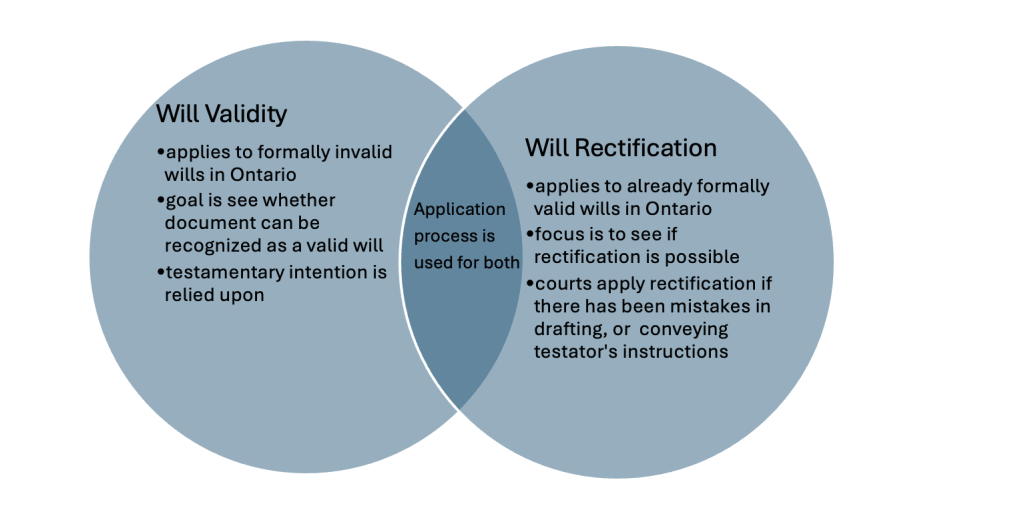
Traditionally, Ontario law required wills to meet strict formalities when assessing the validity of wills including:
- Being in writing
- Signed by the testator (the person making the will)
- Signed in the presence of two witnesses
- Witnesses signing in the presence of the testator
Ontario’s “Substantial Compliance” Rule
Ontario has now modernized estate laws to better reflect a deceased person’s intentions. In 2022, under the Succession Law Reform Act, s.21.1 now allows courts to have the power to validate a will that not typically meet all formal requirements if there is clear evidence that the deceased indented the document to be their final will
Section 21.1(1) now allows courts to consider validating:
- Unsigned or partially signed wills
- Wills with only one witness
- Draft wills that were never formally executed
- Informal documents created shortly before death
The will must clearly describe fixed and final intentions of the deceased, and this may be indicated by:
- The wording of the document
- The circumstances in which it was created (such as creating the will close to when the person was passing away)
- The statements made by the deceased telling others this is their final will
What Does Rectifying a Will Mean?
In Ontario, rectification allows a court to fix any drafting mistakes in a will where the written document does not accurately reflect the deceased’s true instructions, despite being an otherwise valid will. To rectify does not mean to change a will because it the will seems unfair to an individual.
Since rectification is not explicitly stated in any section of the SLRA, Ontario courts rely on inherent jurisdiction and common law principles to detect and correct certain errors they see fit within the document.
Ontario courts have a strict standard when it comes to rectifying wills, therefore only rectifying them in very clear and rare circumstances and must be satisfied that:
- The will in question is formally valid
- There is a clear error in the document
- The error occurred during drafting or recording of the will
- There is clear and substantial evidence indicating the deceased’s true intentions
When Can a Will Be Rectified?
Ontario courts most often rectify a based on 3 different situations, as confirmed in Rondel v Robinson Estate , 2011ONCA 493 :
- Where there is an unintended omission based off a typographical or clerical error
- Where the instructions of the testator have been misunderstood or misconstrued
- Where the instructions of the testator have not been carried out.
How Gale Law Can Help You
The process to validate or rectify a will can be technical, challenging, and quite complex. Preparing a poorly drafted application will likely hurt your chances of having your document validated or rectified. It is important to get in touch with an estate litigator to help you navigate through the uncertainties of the legal process. At Gale Law, we practice exclusively estate litigation and have experience in acting for clients who wish to validate a will.
Frequently Asked Questions
While they are flexible, the courts will not speculate a deceased’s intentions, nor will they validate documents if they believe are created under undue influence, fraudulent intentions, or lack of capacity.
If you are an executor, beneficiary or someone who has interest in the will, such as an affected party, you can apply to the Ontario Superior Court of Justice
Courts will not change a will because someone finds the intentions unfair, guess the intentions of the deceased, nor will they add or remove any gifts that the deceased never clearly instructed.
Beneficiaries, affected parties who have an interest in the will, as well as executors may apply to the Ontario Superior Court of Justice for rectification
Let’s Talk Law
We simplify legal talk so you don’t have to Google it. Tips, trends, and thought pieces straight from our attorneys to help you stay ahead.